BOXED WARNING: CARDIOMYOPATHY, INFUSION REACTIONS, EMBRYO-FETAL TOXICITY,
AND PULMONARY TOXICITY
See full prescribing information for complete boxed warning
Cardiomyopathy: Trastuzumab products can result in subclinical and clinical cardiac failure
manifesting as CHF, and decreased LVEF, with greatest risk when administered concurrently with
anthracyclines. Evaluate cardiac function prior to and during treatment. Discontinue HERCESSI
for cardiomyopathy.
Infusion Reactions, Pulmonary Toxicity: Discontinue HERCESSI for anaphylaxis, angioedema,
interstitial pneumonitis, or acute respiratory distress syndrome.
Embryo-Fetal Toxicity: Exposure to trastuzumab products during pregnancy can result in
oligohydramnios, in some cases complicated by pulmonary hypoplasia and neonatal death. Advise
patients of these risks and the need for effective contraception.
Cardiomyopathy
- Trastuzumab products can result in sub-clinical and clinical cardiac failure. The
incidence and severity was highest in patients receiving trastuzumab with
anthracycline-containing chemotherapy regimens. Trastuzumab products can cause left ventricular cardiac dysfunction, arrhythmias, hypertension,
disabling cardiac failure, cardiomyopathy, and cardiac death
- Trastuzumab products can also cause asymptomatic decline in left ventricular ejection fraction
(LVEF)
- Discontinue HERCESSI treatment in patients receiving adjuvant therapy and withhold HERCESSI in
patients with metastatic disease for clinically significant decrease in left ventricular
function
Cardiac Monitoring
- Evaluate cardiac function prior to and during treatment. For adjuvant therapy, also evaluate cardiac function after completion of HERCESSI
- Conduct thorough cardiac assessment, including history, physical examination, and determination of LVEF by echocardiogram or MUGA scan
- Monitor frequently for decreased LVEF during and after HERCESSI treatment
- Monitor more frequently if HERCESSI is withheld for significant left ventricular cardiac dysfunction
Infusion Reactions
- With trastuzumab products, serious and fatal infusion reactions have been reported
- Symptoms usually occur during or within 24 hours of trastuzumab product administration
- Interrupt HERCESSI infusion for dyspnea or clinically significant hypotension
- Monitor patients until symptoms completely resolve
- Discontinue HERCESSI for severe infusion reactions manifesting as anaphylaxis, angioedema, interstitial
pneumonitis, or acute respiratory distress syndrome. Strongly consider permanent discontinuation
in all patients with severe infusion reactions
- Infusion reactions consist of a symptom complex characterized by fever and chills, and on
occasion include nausea, vomiting, pain (in some cases at tumor sites), headache, dizziness,
dyspnea, hypotension, rash, and asthenia
Embryo-Fetal Toxicity
- Exposure to trastuzumab products during pregnancy can result in oligohydramnios and
oligohydramnios sequence manifesting as pulmonary hypoplasia, skeletal abnormalities, and
neonatal death. Advise patients of these risks and the need for effective
contraception
- Verify the pregnancy status of females of reproductive potential prior to the initiation of
HERCESSI
- Advise females of reproductive potential to use effective contraception during treatment and for
at least 7 months following the last dose of HERCESSI. Advise female patients to contact their
healthcare provider with a known or suspected pregnancy
- Consider the developmental and health benefits of breastfeeding along with the mother’s clinical
need for HERCESSI treatment and any potential adverse effects on the breastfed child from
HERCESSI or from the underlying maternal condition
Pulmonary Toxicity
- Trastuzumab products can result in serious and fatal pulmonary toxicity, which
includes dyspnea, interstitial pneumonitis, pulmonary infiltrates, pleural effusions,
non-cardiogenic pulmonary edema, pulmonary insufficiency and hypoxia, acute respiratory distress
syndrome, and pulmonary fibrosis. Such events can occur as sequelae of infusion reactions
- Patients with symptomatic intrinsic lung disease or with extensive tumor involvement of the
lungs, resulting in dyspnea at rest, appear to have more severe toxicity
Exacerbation of Chemotherapy-Induced Neutropenia
- In randomized, controlled clinical trials, the per-patient incidences of NCI-CTC Grade 3-4
neutropenia and of febrile neutropenia were higher in patients receiving trastuzumab in
combination with myelosuppressive chemotherapy as compared to those who received chemotherapy
alone. The incidence of septic death was similar among patients who received trastuzumab and
those who did not
Most Common Adverse Reactions
- The most common adverse reactions associated with trastuzumab products in breast cancer are fever, nausea, vomiting, infusion reactions, diarrhea, infections,
increased cough, headache, fatigue, dyspnea, rash, neutropenia, anemia, and myalgia
- The most common adverse reactions associated with trastuzumab products in metastatic gastric cancer were neutropenia, diarrhea, fatigue, anemia, stomatitis, weight loss, upper respiratory tract infections, fever, thrombocytopenia, mucosal inflammation, nasopharyngitis, and dysgeusia
To report SUSPECTED ADVERSE REACTIONS, contact Accord BioPharma Inc at 1-866-941-7875 or FDA at 1-800-FDA-1088 or www.fda.gov/medwatch.
Indications
Select patients for therapy based on an FDA-approved companion diagnostic for a trastuzumab product.
Adjuvant Breast Cancer
HERCESSI® (trastuzumab-strf) is indicated in adults for adjuvant treatment
of HER2-overexpressing node positive or node negative (ER/PR-negative or with one high-risk feature)
breast cancer:
- as part of a treatment regimen containing doxorubicin, cyclophosphamide and either paclitaxel or
docetaxel
- as part of a treatment regimen with docetaxel and carboplatin
- as a single agent following multi-modality anthracycline-based therapy
Metastatic Breast Cancer
HERCESSI is indicated in adults:
- in combination with paclitaxel for the first-line treatment of HER2-overexpressing metastatic
breast cancer
- as a single agent for treatment of HER2-overexpressing breast cancer in patients who have
received one or more chemotherapy regimens for metastatic disease
Metastatic Gastric Cancer
HERCESSI is indicated in adults, in combination with cisplatin and capecitabine or 5-fluorouracil,
for the treatment of patients with HER2-overexpressing metastatic gastric or gastroesophageal
junction adenocarcinoma, who have not received prior treatment for metastatic disease.
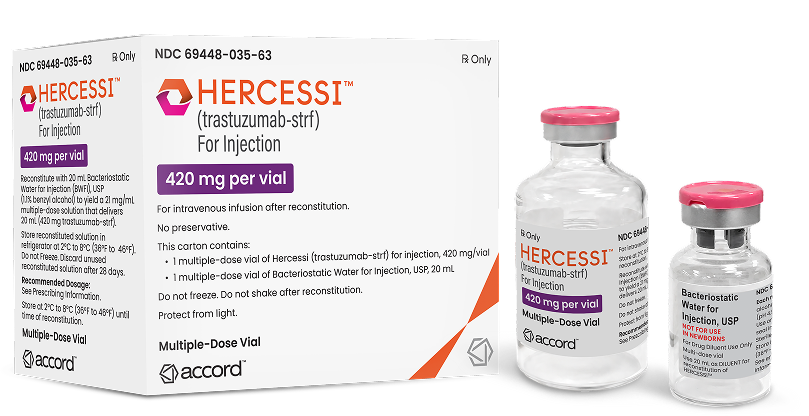
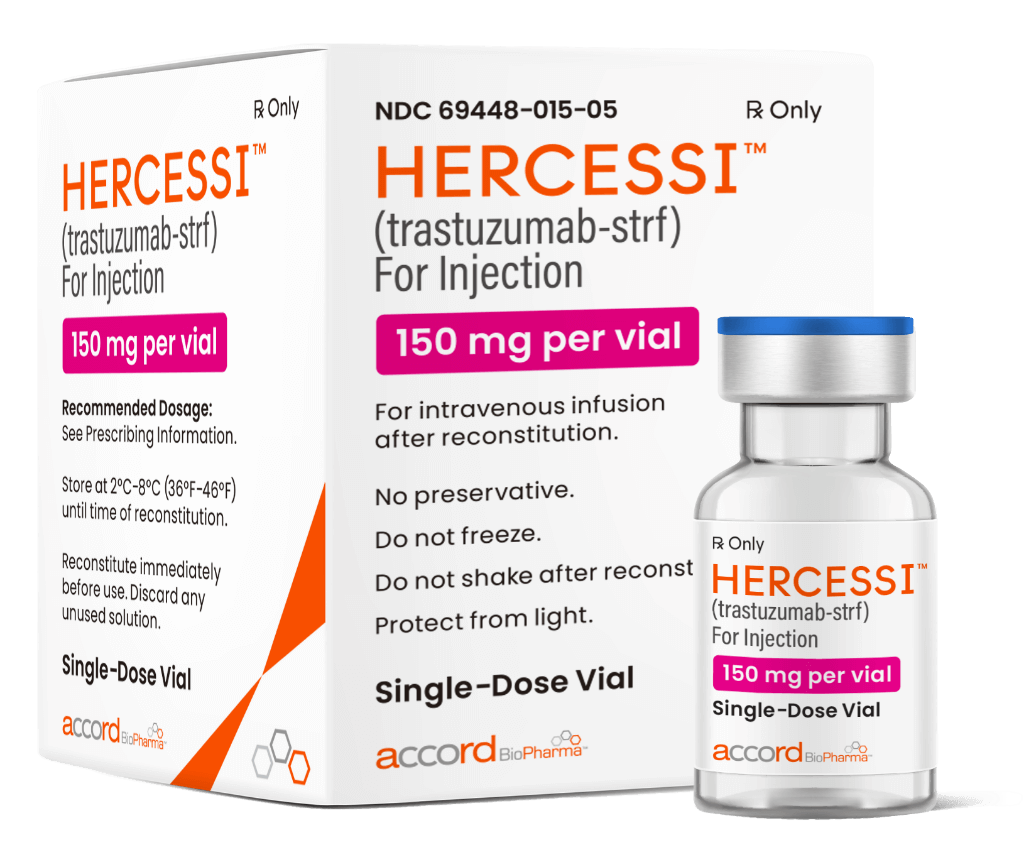
HERCESSI® (trastuzumab-strf) for injection is available as a single-dose vial for the 150
mg/vial strength and as a multiple-dose vial for the 420 mg/vial strength.
Click here for full Prescribing Information, including Boxed
Warnings.
References
- HERCESSI. Prescribing Information. Accord BioPharma, Inc.
- HERCEPTIN. Prescribing Information. Genentech.
- Accord BioPharma, Inc. announces U.S. Food & Drug Administration approval of Hercessi
(trastuzumab-strf), a biosimilar to Herceptin (trastuzumab) for the treatment of several
forms of HER2-overexpressing cancer. News release. PRNewswire; April 29, 2024.
- Xu B, Zhang Q, Sun T, et al; HLX02-BC01 Investigators. Efficacy, safety, and immunogenicity
of HLX02 compared with reference trastuzumab in patients with recurrent or metastatic
HER2-positive breast cancer: a randomized phase III equivalence trial. BioDrugs. 2021;35(3):337-350.
References
- HERCESSI. Prescribing Information. Accord BioPharma, Inc.
- HERCEPTIN. Prescribing Information. Genentech.
- Accord BioPharma, Inc. announces U.S. Food & Drug Administration approval of Hercessi (trastuzumab-strf), a biosimilar to Herceptin (trastuzumab) for the treatment of several forms of HER2-overexpressing cancer. News release. PRNewswire; April 29, 2024.
- Xu B, Zhang Q, Sun T, et al; HLX02-BC01 Investigators. Efficacy, safety, and immunogenicity of HLX02 compared with reference trastuzumab in patients with recurrent or metastatic HER2-positive breast cancer: a randomized phase III equivalence trial. BioDrugs. 2021;35(3):337-350.
HERCEPTIN® (trastuzumab) is a registered trademark of Genentech USA, Inc.